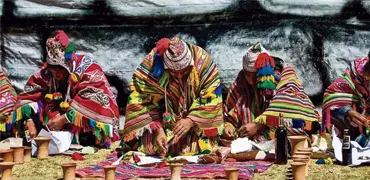
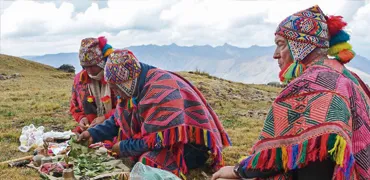
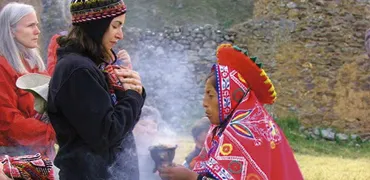
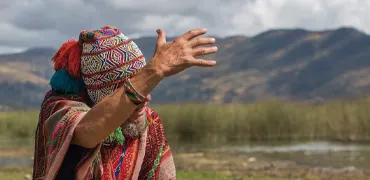
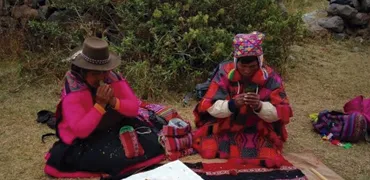
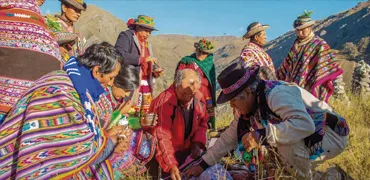
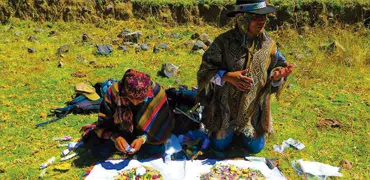
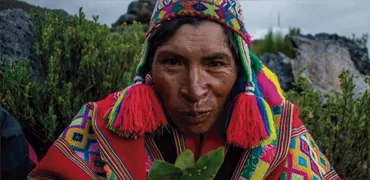
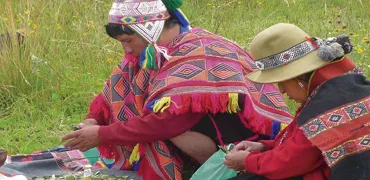
Most Pachamama ceremonies in the Sacred Valley are offered by cultural guides with limited ceremonial training. Peru Alive works exclusively with a master Paqo — a trained Andean priest whose entire life has been devoted to the sacred practice of Haywakuy (offering). When you participate in a Despacho ceremony with a lineage holder, the experience is felt at a fundamentally different depth. Every element of the offering — the coca leaves, the flowers, the chicha, the sacred fire — is placed with deliberate intention rooted in generations of Andean cosmological knowledge.
Our Paqo (Andean priest) was born into the Q'ero or Aymara tradition — the same unbroken spiritual lineage that has performed the Despacho ceremony for over 3,000 years, long before the Inka empire. This is not a recreated ritual.
A professional spiritual guide and translator (Quechua / Spanish → English) accompanies you from hotel pickup to return transfer, ensuring every prayer, symbol and offering is fully understood and personally meaningful.
From the opening coca leaf greeting at 8:30 AM through the sacred fire offering and closing blessing at 6:00 PM — a complete, unhurried ceremonial arc with time for genuine connection and integration.
Shaman, guide, all ceremonial supplies, transport to and from the Sacred Valley, pilgrimage to the Waka, herbal teas and bonfires — every element of the ritual is included. No hidden extras.
The Despacho ceremony — known in Quechua as Haywakuy — is the central ritual act of Andean spirituality. Haywakuy means ‘to offer’ or ‘to feed,’ and the Despacho is literally a gift: a mandala of sacred elements offered to Pachamama (Mother Earth), the Apus (mountain spirits) and the forces of Hanan Pacha (the world above).
Every element placed in the offering carries specific meaning within Andean cosmology: coca leaves (kuka) serve as messengers between worlds; white flowers represent purity and gratitude; corn (sara) symbolizes abundance and collective nourishment; colored wool ribbons map the four suyos (directions); chicha (fermented corn drink) is the libation that seals the reciprocity between humans and the earth.
The finished offering is then consumed by the Willka Nina — the sacred fire — releasing its energy and prayers into the universe. According to Andean tradition, when Pachamama receives a sincere and correctly assembled Despacho, she responds with ayni: reciprocity, balance and flow in the life of the giver.
Despacho vs Pachamama Ceremony — are they the same?
Yes and no. ‘Pachamama ceremony’ is the broader description: any ritual in which offerings are made to the earth. ‘Despacho’ is the specific ritual technology — the assembled mandala of sacred elements — that forms the heart of the most common Andean offering. Our ceremony includes both: a full Despacho assembly process and its ceremonial delivery to Pachamama through the sacred fire.
Who participates in a Despacho ceremony?
Travelers seeking a genuine connection with Andean spiritual tradition. Couples and families marking life transitions (marriage, birth, new chapter). Spiritual seekers who want to work with the principle of ayni (sacred reciprocity) in their lives. Groups of 2 to 8 people — intimate enough for the ceremony to remain truly personal.
$ 300.00
$ 200.00 per person
$ 175.00 per person
The price includes everything: master Paqo shaman, English-speaking spiritual guide and translator, all ceremonial supplies for the Despacho (coca leaves, flowers, chicha, corn, sacred objects), transportation within the Sacred Valley, pilgrimage to the Willka Waka, herbal teas and bonfires throughout the day. The only items not included are personal meals and discretionary tips.
Minimum group size: 2 participants. Solo travelers are welcome — contact us and we will match you with an upcoming group ceremony. Private bookings for larger groups (up to 8) are available year-round at custom rates.
A small deposit confirms your date · Balance paid on arrival in Cusco.
From the morning pickup to the closing circle at sunset, every moment of your Despacho ceremony near Cusco is carefully sequenced by the Paqo and your bilingual guide. Expand each time block to read the full description.
Pickup from your hotel in the Sacred Valley of the Incas (Urubamba). We can also arrange pickup from Cusco or another location (additional transport cost applies). During the transfer, your bilingual guide provides a brief introduction to Kay Pacha (this world), Hanan Pacha (the world above) and Ukhu Pacha (the inner world) — the three planes of Andean cosmology that structure the ceremony you are about to enter.
Arrival at the Shaman’s House in the Sacred Valley. Ritual greeting with coca leaves: k’intus — the ceremonial selection of three perfect leaves — accompanied by the words: “Sulpayki, Pachamama, rikhuykuykita hamuq” (Thank you, Mother Earth, receive our presence). The Paqo explains the meaning of energetic cleansing, the structure of the Despacho offering and how to work with personal intention inside the ceremony. Space is opened for participants to share their reasons for attending.
A gentle pilgrimage toward the Waka (sacred site), following the path of the Willka Mayu (sacred river). As you walk, the guide leads a living meditation on ayni (sacred reciprocity) and munay (universal love) — the two pillars of Andean ethics — and how to integrate them into everyday life, work and relationships. This walk is the ceremony’s energetic preparation: time to arrive fully in the body and in the landscape before the offering begins.
Tasting of traditional local foods: quinoa, potatoes, choclo (Andean corn), seasonal fruits and herbal infusions prepared from plants found in the Sacred Valley. Optional: lunch at a nearby tourist restaurant in Urubamba (not included in price). This pause is intentional — nourishment before the main ceremony is part of the ritual preparation in Andean tradition.
Pichaq Hampi — healing cleansing — is performed individually for each participant. The Paqo uses freshly harvested flowers, purifying and aromatic herbs, and Pugio Yaku (sacred spring water) to remove accumulated emotional and energetic burdens from the physical and subtle body. Each participant receives a soplo (sacred breath) and a samay (transmission of vital energy). This is the ceremony’s purification step — arriving clean before offering to Pachamama.
Together, the group assembles the materials for the Haywakuy (Despacho offering). The Paqo presents each element and its meaning: coca leaves (kuka) — messengers between worlds; corn (sara) — abundance and sustenance; chicha — sacred libation; flowers — beauty and gratitude; colored wool — the four directions; seeds — potential and new beginnings; symbolic objects (sullu, llama fat, confetti, incense) — communication with the Apus. Participants handle and bless each element before it is incorporated into the mandala.
A deeper explanation of the symbolic language that underlies the Despacho. The Paqo walks the group through the cosmological significance of each category of offering: plant kingdom, animal kingdom, mineral kingdom and the world of human intention. Participants learn how to ‘speak’ the offering — how to channel a specific prayer, healing or gratitude into each element as it is placed. This understanding transforms the assembly from a craft activity into a genuine spiritual act.
The core of the day. The Paqo leads the invocation of the tutelary Apus: Apu Ausangate, Apu Salkantay, Apu Pitusiray, Apu Verónica, Apu Yawar Maky, Apu Chikon and others present in the Sacred Valley. Each participant places their personal intention into the completed Despacho. The offering is then wrapped, sealed and delivered to the Willka Nina (sacred fire) — the act through which Pachamama receives the gift and releases the accumulated prayers. Andean and Amazonian chants accompany the burning.
Words of gratitude from the Paqo: “Tupananchiskama” (Until we meet again). A farewell circle with ceremonial Andean music — pututo (conch shell), drum and quena (Andean flute). Brief integration circle: participants share any impressions, images or feelings that arose during the ceremony. The guide offers a short integration framework to carry the experience home. Return transfer to your hotel in the Sacred Valley.
Pick-up from your hotel in the Sacred Valley, transfer, and reception at the Shaman’s house.
Professional tourism guide, spiritual guide, and translator (Quechua/Spanish to English).
Authentic master shaman from the Q’ero or Aymara community, from the spiritual and philosophical school.
(Short) pilgrimage to the Willka Waka in the Sacred Valley of the Incas.
Necessary shamanic implements.
Transportation for the pilgrimage.
All shamanic supplies for rituals and offerings.
Herbal teas, coffee, tea, fruits. During the ceremony, bonfires.
Return transportation to your hotel in the Sacred Valley.
One of the most meaningful aspects of participating in a Despacho ceremony in Cusco is understanding the cosmological language encoded in the offering itself. Below is a guide to the principal elements your Paqo will work with — knowing their meaning allows you to place genuine intention into each piece as the mandala is assembled.
The most sacred plant in Andean tradition. Coca leaves are messengers between the human world and the world of the Apus and Pachamama. Three leaves selected together form a k'intu — a prayer in plant form. The Paqo breathes intention into each k'intu before placing it in the Despacho.
Flowers represent beauty, gratitude and the offering of one's finest quality to Pachamama. In Andean cosmology, beauty is not aesthetic — it is a moral quality: the alignment between intention and action.
Corn is the symbol of abundance and collective nourishment. In Andean tradition it represents the capacity of the earth to provide when human beings live in reciprocity (ayni) with her.
The sacred libation prepared from fermented corn. Chicha is offered to the earth as a direct act of reciprocity — giving back to Pachamama the fertility she has provided. The act of pouring chicha is called ch'alla.
The four colors map the four suyos (directions) of the Tawantinsuyu (the Inka world): red (south / Collasuyo), white (west / Cuntisuyo), yellow (north / Chinchasuyo), green (east / Antisuyo). Together they invoke harmony of the four directions around the ceremony.
Seeds represent potential, new beginnings and the cycle of planting intention in the world. The participant places their personal prayer into the seeds before they are incorporated into the offering.
Traditional elements with deep symbolic charge in the Andean spiritual tradition. The Sullu (dried llama fetus) is a symbol of abundance, fertility and renewal — a request for full and complete life. Llama fat feeds the sacred fire.
The fire is not just the delivery mechanism — it is itself a sacred entity. Willka Nina means 'sacred fire of rebirth.' When the Despacho is placed in the fire, the Paqo reads the way it burns to understand Pachamama's response: clear, even burning is a positive sign.
Perhaps the most important element of all. Before the ceremony, your guide helps you clarify a sincere personal intention — a healing, a gratitude, a new beginning. This intention is woven into every element you touch throughout the assembly and transmitted to Pachamama through the fire.
Tell us your preferred dates and group size. We confirm availability within 24 hours, hold your place and send your preparation guide. No payment required to enquire — just reach out and we will take care of the rest.
Prefer to speak first? Message us on WhatsApp — we reply the same day.
These are the questions we receive most often from travelers considering a Despacho ceremony near Cusco. If yours is not answered here, contact us directly — we are happy to speak before you book.
A Despacho ceremony (Haywakuy in Quechua) is a traditional Andean offering ritual in which sacred elements — coca leaves, flowers, corn, chicha, seeds and symbolic objects — are assembled into a mandala and offered to Pachamama (Mother Earth) and the Apus (mountain spirits) through the sacred fire. ‘Pachamama ceremony’ is the broader term; ‘Despacho’ is the specific ritual form. Our experience includes both: a complete Despacho assembly and its delivery to Pachamama through the Willka Nina (sacred fire).
The full ceremony lasts one day, from 8:30 AM to approximately 6:00 PM. It begins with pickup from your hotel in Urubamba (Sacred Valley), includes a sacred walk to the Waka along the Willka Mayu (sacred river), a traditional Andean lunch break, the energetic cleansing (Pichaq Hampi), Despacho assembly and teaching, the central fire offering, and closes with a farewell circle and return transfer.
The ceremony visits four sacred locations within the Sacred Valley of the Incas: the Shaman’s House (main ceremony venue), the Waka (sacred site reached during the pilgrimage), the Willka Mayu (sacred river, walked during the integration pilgrimage) and Urubamba (pickup and return point). All locations are within the Sacred Valley — approximately 1.5 hours from Cusco city by road.
Prices per person for the 2026–2027 season (minimum 2 participants): 2 participants: $175.00 USD per person · 3 or more participants: $120.00 USD per person. The price includes: shaman, guide and translator, all ceremonial supplies, Sacred Valley transport, pilgrimage, herbal teas and bonfires. Not included: personal meals and tips. Solo travelers and larger groups (up to 8) — contact us for options.
The ceremony is guided by an authentic Paqo (Andean priest) from the Q’ero or Aymara community, trained in the spiritual and philosophical school of Andean tradition. A professional bilingual guide and translator (Quechua / Spanish → English) accompanies the group throughout. The Paqo does not speak English directly but communicates through the guide, who is also trained in Andean spirituality and ceremony.
Included: pickup from your hotel in the Sacred Valley, transfer and reception at the Shaman’s House, professional spiritual guide and translator (Quechua/Spanish to English), authentic Paqo shaman, pilgrimage to the Willka Waka, transportation for the pilgrimage, all shamanic implements and ceremonial supplies for the Despacho (coca, flowers, chicha, corn, wool, seeds, incense, etc.), herbal teas, coffee and fruits, bonfires. Not included: meals and tips.
The Despacho assembled in our ceremony includes: coca leaves (kuka) — the messenger plant; white and colored flowers — beauty and gratitude; corn (sara) — abundance; chicha — sacred libation; colored wool ribbons — the four directions; seeds — intention and new beginnings; symbolic objects (sullu, llama fat, confetti, incense); and each participant’s personal intention, woven into every element they handle. The Paqo explains the meaning of each element as the mandala is assembled together.
Pickup from hotels in the Sacred Valley of the Incas (Urubamba) is included in the price. Pickup from Cusco city or another location is also available and is very commonly requested — an additional transport cost applies, which we will confirm when you enquire. Return transportation to your hotel in the Sacred Valley (or Cusco, if arranged) is also included.
We recommend arriving with a clear personal intention — a healing, gratitude or new beginning you want to offer to Pachamama. Eat a light breakfast and avoid heavy food, alcohol or other substances the day before. Dress in comfortable, layered clothing (Sacred Valley mornings are cool, afternoons can be warm). Bring a small journal if you enjoy writing after ceremonies. We send you a detailed preparation guide after you book.
Yes. Many participants arrive with curiosity rather than a formal spiritual practice. The bilingual guide explains every step in clear, accessible terms so the ceremony is meaningful whether you come from a spiritual background or simply want to engage respectfully with Andean living culture. The Despacho is a cultural and spiritual experience — full participation is invited but never imposed.
The minimum group size is 2 participants. Solo travelers are warmly welcomed — contact us and we will connect you with an upcoming group ceremony date so you can participate at the per-person rate. Private group ceremonies for up to 8 participants are available year-round with advance notice.
Yes. The Despacho ceremony is a living expression of indigenous Andean spiritual heritage, practised continuously in the Andes for over 3,000 years. It is recognized as part of Peru’s living intangible cultural heritage and is conducted within its traditional ceremonial context by a lineage Paqo from the Q’ero or Aymara community.
Absolutely. The majority of our participants are first-time visitors to Andean ceremony. The Paqo and your bilingual guide create a safe, welcoming and fully explained experience from arrival to closing circle. No prior knowledge of Quechua, Andean cosmology or ceremonial practice is required — only openness and a sincere intention.
Submit your preferred dates, group size and any questions through the contact form on this page. We confirm availability within 24 hours and hold your place with a small deposit. The balance is paid on arrival in Cusco. We recommend booking at least 3–7 days in advance to allow time for preparation guidance, but last-minute requests are possible — just contact us directly via WhatsApp.